
Most personal injury lawyers in Houston charge nothing upfront and work on a contingency fee, which typically runs between 33% and 40% of whatever the lawyer recovers for you. My fee is 33% if your case settles before a lawsuit is filed, 40% after a lawsuit is filed, and 45% if the case goes to appeal. There is no fee unless I win. I’ve been practicing law for about 25 years, and in all those years, the money question is usually the first one an injured person asks me.
The percentage is only part of the answer, though. You also need to know about case expenses, medical bills, and how the math works from the settlement check down to the amount you keep. I’ll walk through all of it here so you can decide whether calling a lawyer makes sense for you.
How Does a Contingency Fee Work?
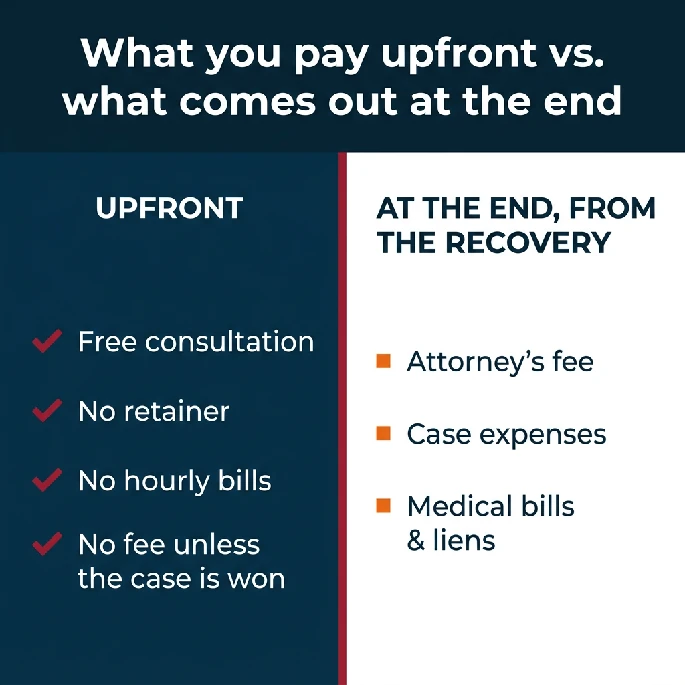
A contingency fee means your lawyer is paid a percentage of the money recovered for you, and only if money is actually recovered. You don’t pay by the hour. You don’t pay a retainer to get started. If the case brings in nothing, the lawyer’s fee is nothing.
This arrangement exists because most injured people can’t afford to pay a lawyer out of pocket. The average Texas attorney bills $366 an hour, and an injury case can take hundreds of hours. On a contingency fee, you never see an hourly bill. The lawyer takes on the risk of the case, and in exchange, the fee comes out of the recovery at the end. That’s what lets someone with a stack of medical bills hire the same caliber of lawyer the insurance company has on its side.
What Percentage Do I Charge?
My contingency fee depends on how far your case has to go before it resolves. Here is my exact structure:
| Stage of your case | My fee |
|---|---|
| Settles before a lawsuit is filed | 33% |
| Resolves after a lawsuit is filed | 40% |
| Case goes to appeal | 45% |
The percentage goes up at each stage because the work goes up. Settling a claim before suit means investigating, gathering your medical records, and negotiating with the adjuster. Filing a lawsuit adds much more: court filings, written discovery (the formal written questions and document requests both sides must answer), depositions, expert witnesses, and trial preparation. All of that takes far more of my time and money. An appeal adds another round of briefing and argument on top of all that.
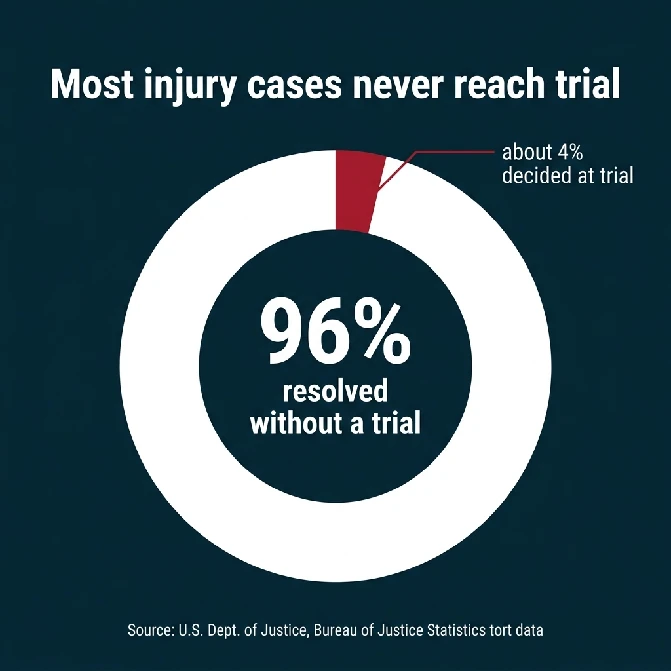
The higher percentages apply less often than you might expect. The vast majority of injury cases resolve without a trial, according to U.S. Department of Justice data. Many of my cases settle before a lawsuit is ever filed, which means the 33% tier applies. Whether your case involves a car accident, a fall, or another kind of injury, the fee structure works the same way.
Do I Pay Anything Upfront?
No. You pay nothing to hire me, and the consultation is free. Free consultations are standard in personal injury law. If a lawyer wants to charge you just to discuss your case, that is a warning sign. It costs you nothing to find out whether you have a case and what it might involve.
What Happens If I Lose My Case?
If I don’t win your case, you owe me no attorney’s fee. That is how a contingency arrangement works: no fee unless I win.
Case expenses are handled separately from the fee. Expenses are the out-of-pocket costs of building the case, like filing fees and records charges, and firms differ on who covers them if a case is lost. A good fee agreement spells out how they are handled. Mine does, and I go over that part with you at the free consultation, before you sign anything.
What Case Expenses Exist Beyond the Fee?
Case expenses are the actual costs of pursuing your claim, and they are separate from the attorney’s fee. The main ones are:
- Court filing fees. Opening a new civil suit in Harris County district court costs $350 in filing fees, and serving the defendant costs extra.
- Medical records. Hospitals and doctors charge to copy and certify your records, and an injury case needs all of them.
- Depositions. A deposition is sworn testimony taken outside of court, recorded by a court reporter. A standard one typically costs $400 to $1,500, and more with video. A litigated case usually needs several.
- Expert witnesses. Experts who review records and testify commonly charge several hundred dollars an hour, and medical experts often charge more. Median rates run about $450 an hour for reviewing records and $500 an hour for trial testimony.
The stage of your case drives how big these expenses get. A claim that settles before suit usually involves modest costs, mostly records and administrative charges. Once a lawsuit is filed, depositions and experts can push expenses into the thousands of dollars. That’s another reason the fee percentage steps up after filing: the lawyer is advancing those costs while the case is fought.
Is the Fee Calculated Before or After Expenses?
There are two ways a contingency percentage can be calculated: on the gross settlement, meaning the full amount, or on the net, meaning what’s left after case expenses are repaid. The difference changes how much money you take home.
A quick example shows the difference. Say a case settles for $100,000 with $10,000 in case expenses. A fee calculated on the gross is 33% of $100,000, which is $33,000. A fee calculated after expenses is 33% of $90,000, which is $29,700. That’s a $3,300 difference, and it goes either to you or to the lawyer depending on how the agreement is written.
You do not have to guess at the answer. Texas ethics rules require a contingency fee agreement to state whether expenses are deducted before or after the fee is calculated. My agreement states it in writing, and it is one of the lines I walk you through before you sign.
What Would I Actually Take Home From a Settlement?
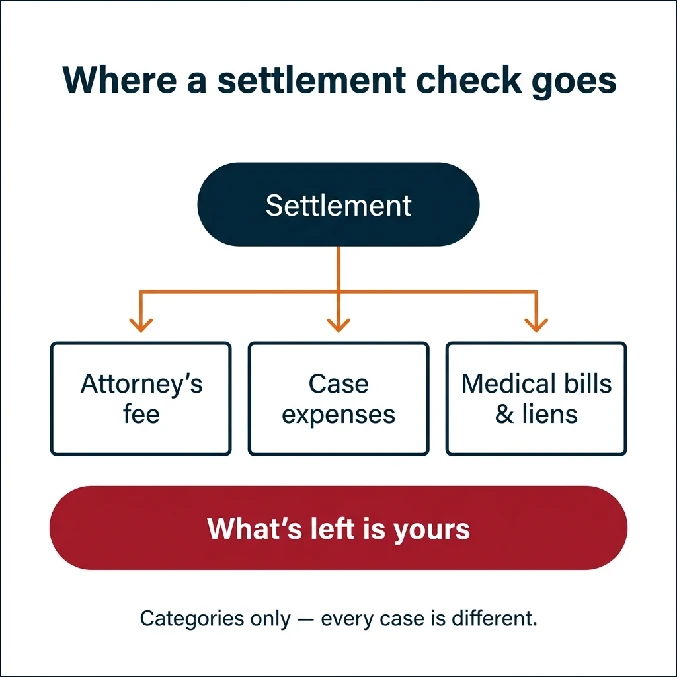
Your take-home amount is the settlement minus three things: the attorney’s fee, the case expenses, and the medical bills or liens paid out of the recovery. Here is a simplified example, with round numbers, of a case that settles before a lawsuit is filed. It is only an illustration of how the math works. Every case is different, and no lawyer can promise you a result.
| Hypothetical settlement breakdown | Amount |
|---|---|
| Settlement | $60,000 |
| Attorney’s fee (33%, pre-suit) | $19,800 |
| Case expenses | $1,200 |
| Medical bills and liens paid from the settlement | $9,000 |
| Your take-home amount | $30,000 |
The medical line surprises people, so let me explain it. In Texas, if you’re admitted to the hospital within 72 hours of an accident caused by someone else’s negligence, the hospital can put a lien on your injury claim. That means the hospital gets paid out of your settlement before the money reaches you. Unpaid medical bills often come out of the recovery the same way.
Negotiating those bills and liens down is part of my job, and every dollar I knock off a hospital lien goes into your pocket, not mine. Handling that negotiation on your own, while you’re still recovering, is hard to do well.
Is Hiring a Personal Injury Lawyer Worth the Cost?

For most injury cases with real medical bills, yes, and there is data behind that answer. In a 2017 national survey of injury claimants, more than nine out of ten people with a lawyer received a settlement or award, compared to about half of the people who handled their claims alone. The represented group also reported far higher average compensation, $77,600 versus $17,600, and that gap held up even after their contingency fees were paid. Those are survey averages, not a promise about your case.
I can also tell you why that gap exists. Before I represented injured people, I defended insurance companies. Adjusters evaluate an unrepresented claim knowing the person has no realistic way to take them to court, and the offers reflect that. When a lawyer who actually files lawsuits is on the claim, the insurer values it differently, because the cheap option of waiting you out is gone.
I’ll also be straight with you when you don’t need me. Some claims are simple enough that you may not need an attorney, and if yours is one of them, I’ll tell you that in the consultation. I also take a hard look at cases other Houston firms turn down, especially slip and fall claims, so don’t assume your case is too small or too difficult before anyone has looked at it.
What Should I Look For in a Fee Agreement?
Texas law requires a contingency fee agreement to be in writing and signed by both you and the attorney. A verbal promise about fees is not enough, so if a lawyer is vague about putting the numbers on paper, walk away. And if the percentage changes by stage, as mine does, the written agreement has to state the percentage for each one, settlement, trial, and appeal.
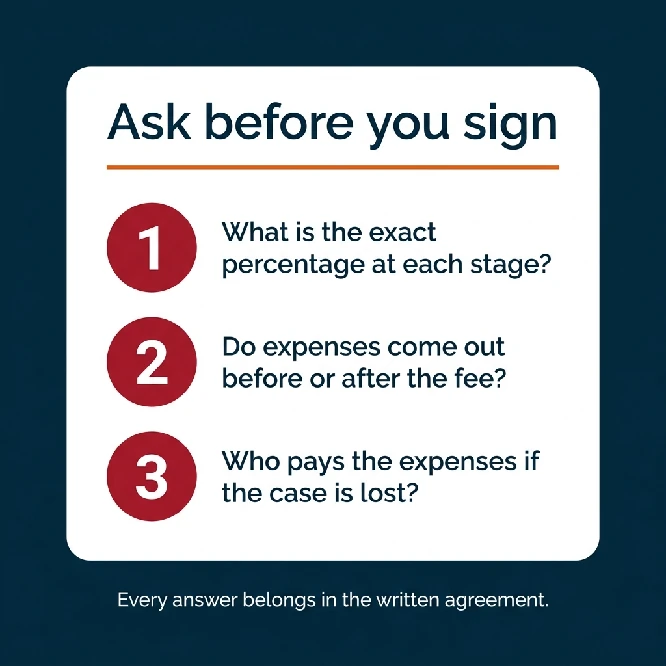
Before you sign, get clear answers on three things: the exact percentage at each stage, whether expenses come out before or after the fee is calculated, and who pays the expenses if the case is lost. Every one of those answers belongs in the written agreement, not in a hallway conversation. And when your case ends, you’re entitled to a written closing statement showing exactly how your check was calculated. I go through mine with clients line by line.
Common Questions About Personal Injury Lawyer Fees
Do I have to pay a personal injury lawyer upfront in Texas?
No. Personal injury lawyers in Texas typically work on contingency, which means no upfront payment, no retainer, and no hourly bills. My consultations are free, and there is no fee unless I win your case.
What percentage do personal injury lawyers take in Texas?
Most Texas personal injury lawyers charge between 33% and 40% of the recovery, with the percentage rising if a lawsuit has to be filed. My structure is 33% before suit, 40% after suit is filed, and 45% on appeal.
Who pays the case expenses if we lose?
It depends on your fee agreement. Some firms absorb the expenses if the case is lost, and others bill the client for them. Your written agreement should spell this out. My agreement covers it, and I go over it with you at the free consultation.
Does the fee go up if a lawsuit is filed?
Usually, yes. Filing suit adds months of extra work, including depositions, expert witnesses, and trial preparation, so most contingency agreements, including mine, step the percentage up at that point. Most injury cases still resolve without a trial.
Is my case too small to be worth a lawyer’s time?
Don’t decide that on your own. Some firms only want large cases, but I take cases other Houston lawyers turn down, and the consultation costs you nothing either way. If your claim is simple enough to handle yourself, I’ll tell you so.
How long do I have to hire a lawyer after an injury in Texas?
Texas generally gives you two years from the date of the injury to file a lawsuit, and some deadlines are shorter. Talking to a lawyer early protects the deadline and the evidence, so don’t wait until the two years are almost gone.
Talk to Me About Your Case, Free
If you were hurt in the Houston area and you’re worried about what a lawyer costs, the answer for you today is nothing. The consultation is free, I only get paid if I win, and my practice covers a wide range of injury cases. My phones are answered 24/7 by a live person, and when you hire me, you work with me, not a case manager you’ve never met. Call or contact me and let’s figure out together whether your case is worth pursuing.
This article is general information about legal fees in Texas, not legal advice about your situation, and reading it does not create an attorney-client relationship. Every case is different. See the full disclaimer.